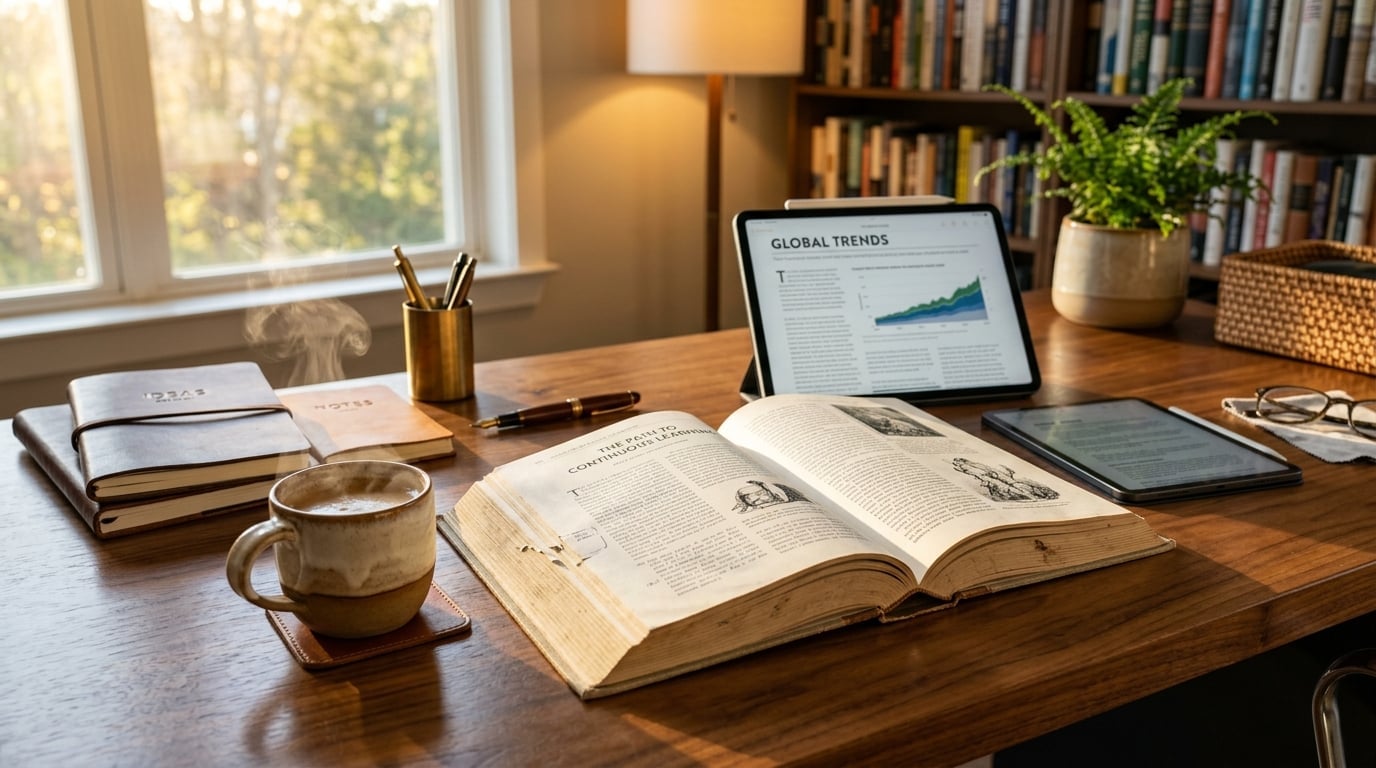

Early in my career, a mentor gave me advice that seemed almost too simple to be valuable: "Read for fifteen minutes every morning before you do anything else." I was skeptical. Fifteen minutes? What could that possibly accomplish when I had meetings to prepare for, emails to answer, and deadlines to meet?
But I tried it. And three decades later, I can tell you with absolute certainty that this single habit has been the most powerful accelerator of my professional growth. Not the MBA. Not the conferences. Not the corner office. Fifteen minutes of intentional daily learning, compounded over years, created a knowledge advantage that opened doors I never could have imagined.
The Math of Compound Learning
Let's do the arithmetic. Fifteen minutes a day equals roughly 91 hours per year. That's the equivalent of more than two full work weeks dedicated exclusively to learning. Over five years, you've invested 455 hours — the equivalent of an entire semester of graduate school. Over a decade, you've accumulated nearly a thousand hours of focused learning. And unlike formal education, this learning is self-directed, immediately relevant, and continuously updated.
But the real power isn't in the hours — it's in the compounding. Each new idea connects to previous ones. Each framework builds on earlier understanding. Each perspective enriches your ability to see patterns others miss. Learning compounds the same way money does: slowly at first, then suddenly.
Why Most Professionals Stop Learning
Despite knowing that continuous learning matters, most professionals functionally stop growing within five to seven years of entering their field. They master the basics, develop competence, and then plateau — not because they lack intelligence, but because they lack a learning system.
The culprit is almost always the urgent crowding out the important. When your calendar is wall-to-wall meetings and your inbox never empties, learning feels like a luxury you can't afford. The irony is that the professionals who invest in learning consistently are the ones who eventually escape the hamster wheel, because they develop the insights and capabilities that make them irreplaceable.
Building Your Fifteen-Minute Learning Practice
Choose Your Medium
Not everyone learns best by reading. Some people absorb information more effectively through podcasts, audiobooks, or video content. The medium doesn't matter — consistency does. Choose the format that you'll actually stick with. If you commute, podcasts might be natural. If you're a morning person, reading over coffee works beautifully. If you're visual, curated video content might be your path.
Diversify Your Sources
The most innovative thinkers draw from multiple disciplines. Don't limit yourself to your industry's trade publications. Read about psychology, history, science, philosophy, and art. The insights that differentiate you won't come from knowing more about your field than anyone else — they'll come from connecting ideas across fields in ways no one else has.
Apply Within 48 Hours
Learning without application is entertainment. For every meaningful idea you encounter, find a way to apply it within 48 hours. Share it in a meeting, test it in a project, write about it, or teach it to a colleague. Application transforms information into knowledge, and knowledge into wisdom.
Keep a Learning Journal
Spend two minutes after your fifteen-minute session writing down one key takeaway. Over time, this journal becomes an incredible resource — a personalized library of insights indexed by your own experience. When you face a new challenge, you'll find that your journal contains relevant wisdom you'd otherwise have forgotten.
The Ripple Effect
What surprised me most about this practice wasn't the knowledge itself — it was how it changed the way people perceived me. When you're the person in the room who brings a fresh perspective, who connects dots others don't see, who references a case study that perfectly illuminates the current challenge, you become the person others want on their team, in their meetings, and at their table.
Learning daily doesn't just make you smarter. It makes you more valuable, more interesting, and more confident. It gives you a quiet authority that credentials alone can't provide.
Fifteen minutes a day. That's all it takes. Not someday — today. Open a book, queue a podcast, watch a lecture. Your future self will thank you for starting now.
From the Book
Where is Your Why?: A Formula of Building Blocks to Attain Success
This article draws on concepts explored in depth in this book by D.A. Abrams.
Explore the BookRecommended Course
Where Is Your Why?
Discover and activate your personal formula for lasting success
Enjoyed This Article?
Get more leadership insights, frameworks, and strategies delivered to your inbox.